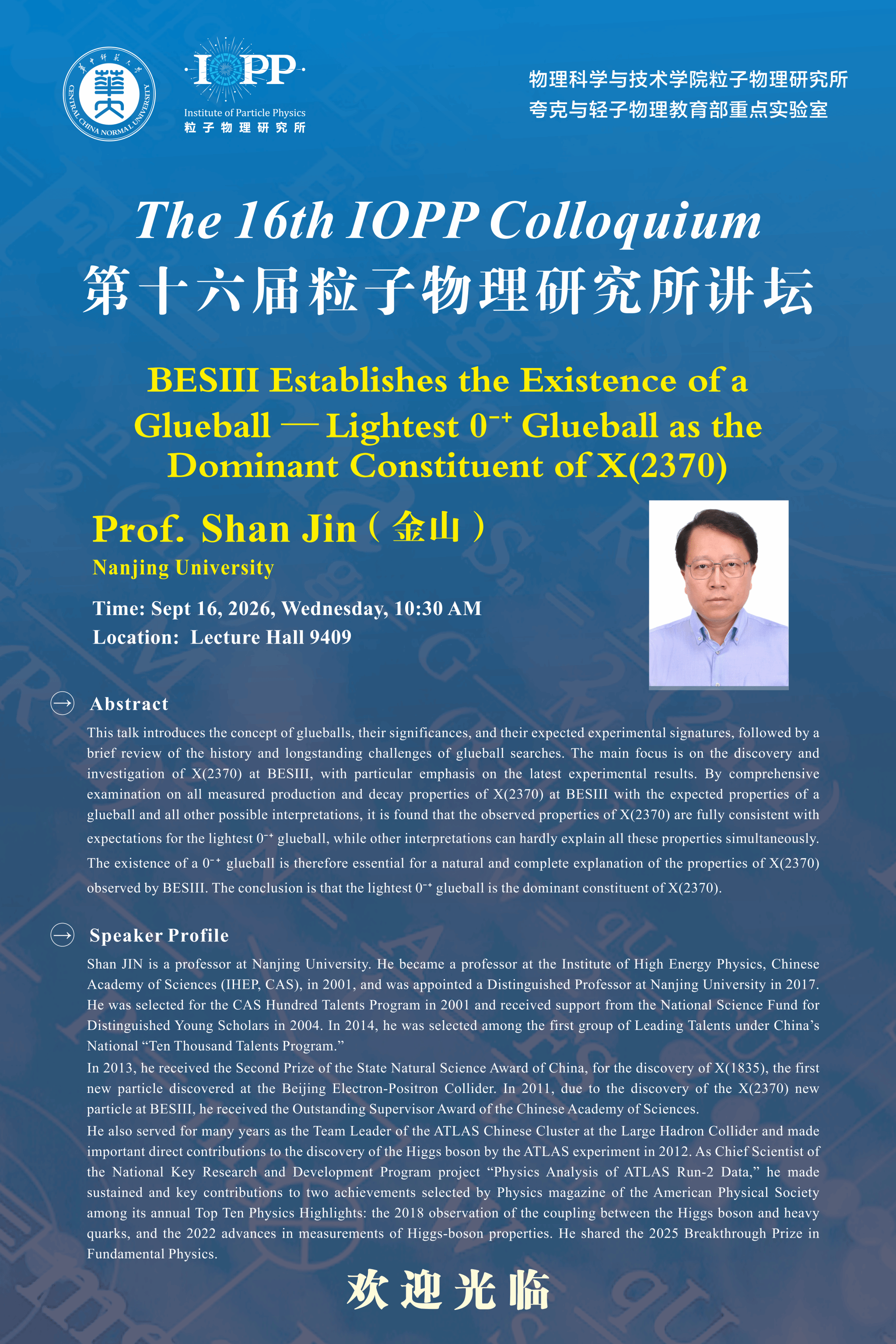
Time: Sept. 16, 2026,Wednesday,10:30 am
Location: Room 9409
Speaker: Shan Jin, Nanjing University
Abstract:
This talk introduces the concept of glueballs, their significances, and their expected experimental signatures, followed by a brief review of the history and longstanding challenges of glueball searches. The main focus is on the discovery and investigation of X(2370) at BESIII, with particular emphasis on the latest experimental results. By comprehensive examination on all measured production and decay properties of X(2370) at BESIII with the expected properties of a glueball and all other possible interpretations, it is found that the observed properties of X(2370) are fully consistent with expectations for the lightest 0⁻⁺ glueball, while other interpretations can hardly explain all these properties simultaneously. The existence of a 0⁻⁺ glueball is therefore essential for a natural and complete explanation of the properties of X(2370) observed by BESIII. The conclusion is that the lightest 0⁻⁺ glueball is the dominant constituent of X(2370).
Biography:
Shan JIN is a professor at Nanjing University. He became a professor at the Institute of High Energy Physics, Chinese Academy of Sciences (IHEP, CAS), in 2001, and was appointed a Distinguished Professor at Nanjing University in 2017. He was selected for the CAS Hundred Talents Program in 2001 and received support from the National Science Fund for Distinguished Young Scholars in 2004. In 2014, he was selected among the first group of Leading Talents under China’s National “Ten Thousand Talents Program.”
In 2013, he received the Second Prize of the State Natural Science Award of China, for the discovery of X(1835), the first new particle discovered at the Beijing Electron-Positron Collider. In 2011, due to the discovery of the X(2370) new particle at BESIII, he received the Outstanding Supervisor Award of the Chinese Academy of Sciences.
He also served for many years as the Team Leader of the ATLAS Chinese Cluster at the Large Hadron Collider and made important direct contributions to the discovery of the Higgs boson by the ATLAS experiment in 2012. As Chief Scientist of the National Key Research and Development Program project “Physics Analysis of ATLAS Run-2 Data,” he made sustained and key contributions to two achievements selected by Physics magazine of the American Physical Society among its annual Top Ten Physics Highlights: the 2018 observation of the coupling between the Higgs boson and heavy quarks, and the 2022 advances in measurements of Higgs-boson properties. He shared the 2025 Breakthrough Prize in Fundamental Physics.
PDF or PPT file download:/X2370_SEPT16_ccnu.pdf.