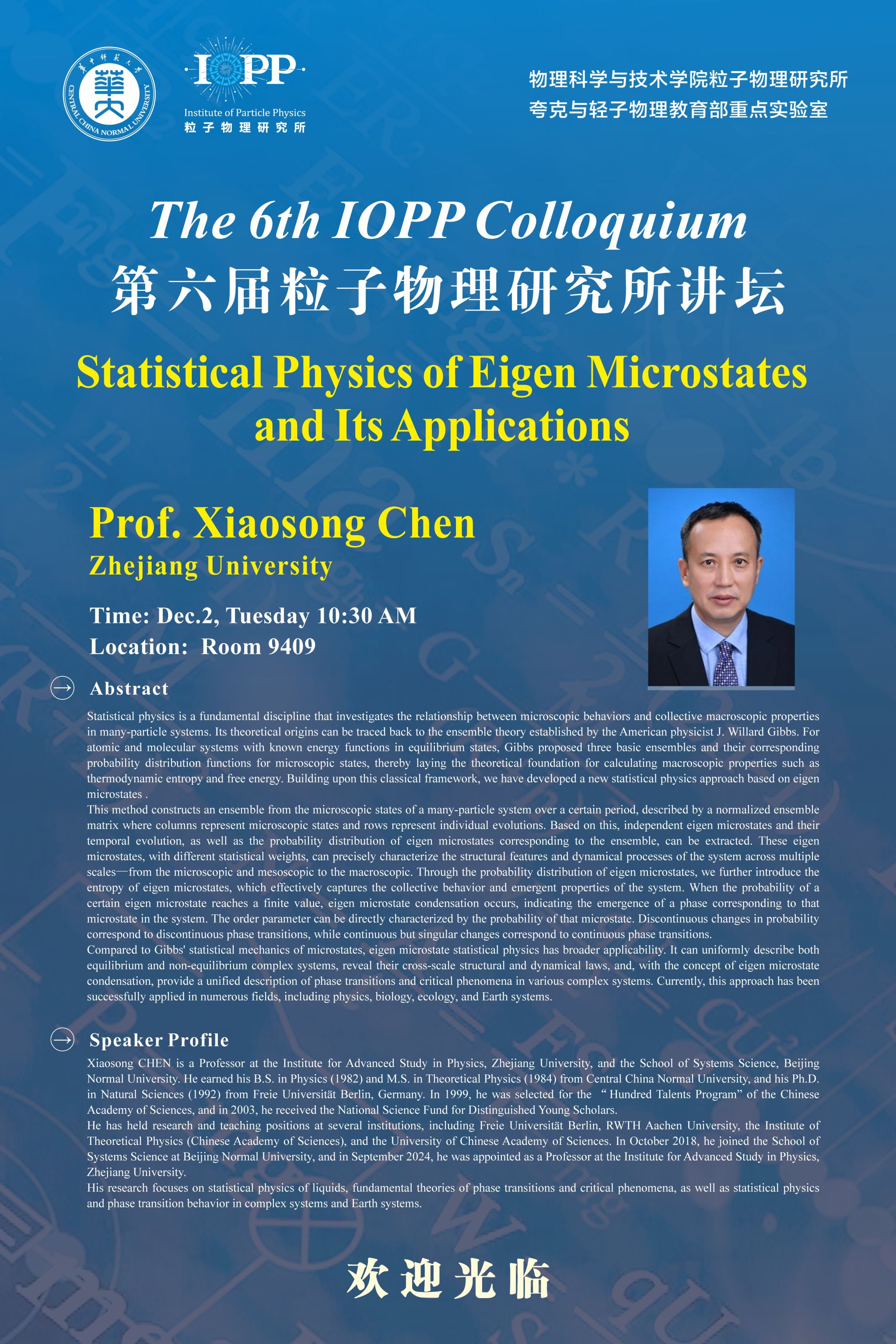
Speaker: Prof. Xiaosong Chen (ZheJiang University)
Time: Dec.2.Tuesday 10:30 AM
Location: Room 9409
Abstract:
Statistical physics is a fundamental discipline that investigates the relationship between microscopic behaviors and collective macroscopic properties in many-particle systems. Its theoretical origins can be traced back to the ensemble theory established by the American physicist J. Willard Gibbs. For atomic and molecular systems with known energy functions in equilibrium states, Gibbs proposed three basic ensembles and their corresponding probability distribution functions for microscopic states, thereby laying the theoretical foundation for calculating macroscopic properties such as thermodynamic entropy and free energy. Building upon this classical framework, we have developed a new statistical physics approach based on eigen microstates.
This method constructs an ensemble from the microscopic states of a many-particle system over a certain period, described by a normalized ensemble matrix where columns represent microscopic states and rows represent individual evolutions. Based on this, independent eigen microstates and their temporal evolution, as well as the probability distribution of eigen microstates corresponding to the ensemble, can be extracted. These eigen microstates, with different statistical weights, can precisely characterize the structural features and dynamical processes of the system across multiple scales—from the microscopic and mesoscopic to the macroscopic. Through the probability distribution of eigen microstates, we further introduce the entropy of eigen microstates, which effectively captures the collective behavior and emergent properties of the system. When the probability of a certain eigen microstate reaches a finite value, eigen microstate condensation occurs, indicating the emergence of a phase corresponding to that microstate in the system. The order parameter can be directly characterized by the probability of that microstate. Discontinuous changes in probability correspond to discontinuous phase transitions, while continuous but singular changes correspond to continuous phase transitions.
Compared to Gibbs' statistical mechanics of microstates, eigen microstate statistical physics has broader applicability. It can uniformly describe both equilibrium and non-equilibrium complex systems, reveal their cross-scale structural and dynamical laws, and, with the concept of eigen microstate condensation, provide a unified description of phase transitions and critical phenomena in various complex systems. Currently, this approach has been successfully applied in numerous fields, including physics, biology, ecology, and Earth systems [4,5,6].
Speaker Profile:
Xiaosong CHEN is a Professor at the Institute for Advanced Study in Physics, Zhejiang University, and the School of Systems Science, Beijing Normal University. He earned his B.S. in Physics (1982) and M.S. in Theoretical Physics (1984) from Central China Normal University, and his Ph.D. in Natural Sciences (1992) from Freie Universität Berlin, Germany. In 1999, he was selected for the “Hundred Talents Program” of the Chinese Academy of Sciences, and in 2003, he received the National Science Fund for Distinguished Young Scholars.
He has held research and teaching positions at several institutions, including Freie Universität Berlin, RWTH Aachen University, the Institute of Theoretical Physics (Chinese Academy of Sciences), and the University of Chinese Academy of Sciences. In October 2018, he joined the School of Systems Science at Beijing Normal University, and in September 2024, he was appointed as a Professor at the Institute for Advanced Study in Physics, Zhejiang University.
His research focuses on statistical physics of liquids, fundamental theories of phase transitions and critical phenomena, as well as statistical physics and phase transition behavior in complex systems and Earth systems.
PPT or PDF file download:/Statistical_Physics_of_Eigen_Microstates_and_Its_Applications.pptx