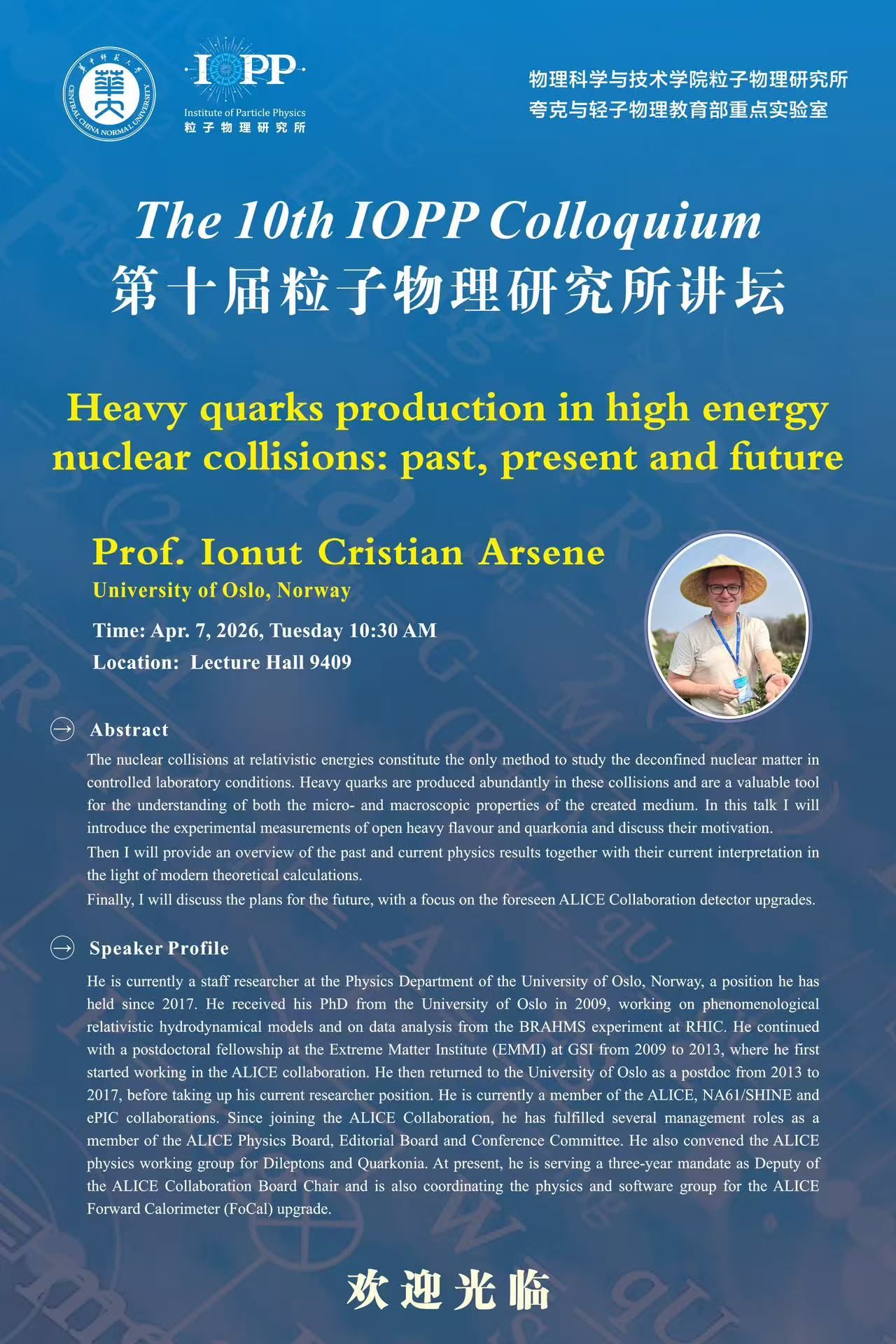
Speaker: Prof. Ionut Cristian Arsene, University of Oslo
Date: Apr. 7, 2026, Tuesday 10:30 AM
Location: Lecture Hall 9409
Abstract:
The nuclear collisions at relativistic energies constitute the only method to study the deconfined nuclear matter in controlled laboratory conditions.Heavy quarks are produced abundantly in these collisions and are a valuable tool for the understanding of both the micro- and macroscopic properties of the created medium. In this talk I will introduce the experimental measurements of open heavy flavour and quarkonia and discuss their motivation.
Then I will provide an overview of the past and current physics results together with their current interpretation in the light of modern theoretical calculations.
Finally, I will discuss the plans for the future, with a focus on the foreseen ALICE Collaboration detector upgrades.
Speaker Profile:
Prof. Ionut Cristian Arsene is currently a staff researcher at the Physics Department of the University of Oslo, Norway, a position he has held since 2017.He received his PhD from the University of Oslo in 2009, working on phenomenological relativistic hydrodynamical models and on data analysis from the BRAHMS experiment at RHIC.He continued with a postdoctoral fellowship at the Extreme Matter Institute (EMMI) at GSI from 2009 to 2013, where he first started working in the ALICE collaboration.He then returned to the University of Oslo as a postdoc from 2013 to 2017, before taking up his current researcher position.He is currently a member of the ALICE, NA61/SHINE and ePIC collaborations.Since joining the ALICE Collaboration, he has fulfilled several management roles as a member of the ALICE Physics Board, Editorial Board and Conference Committee.He also convened the ALICE physics working group for Dileptons and Quarkonia. At present, he is serving a three-year mandate as Deputy of the ALICE Collaboration Board Chair and is also coordinating the physics and software group for the ALICE Forward Calorimeter (FoCal) upgrade.
PPT or PDF download: /doc/IArsene_IOPPColloquium.pdf